Submissions

Login or Register to make a submission.

Author Guidelines

1. About JELI

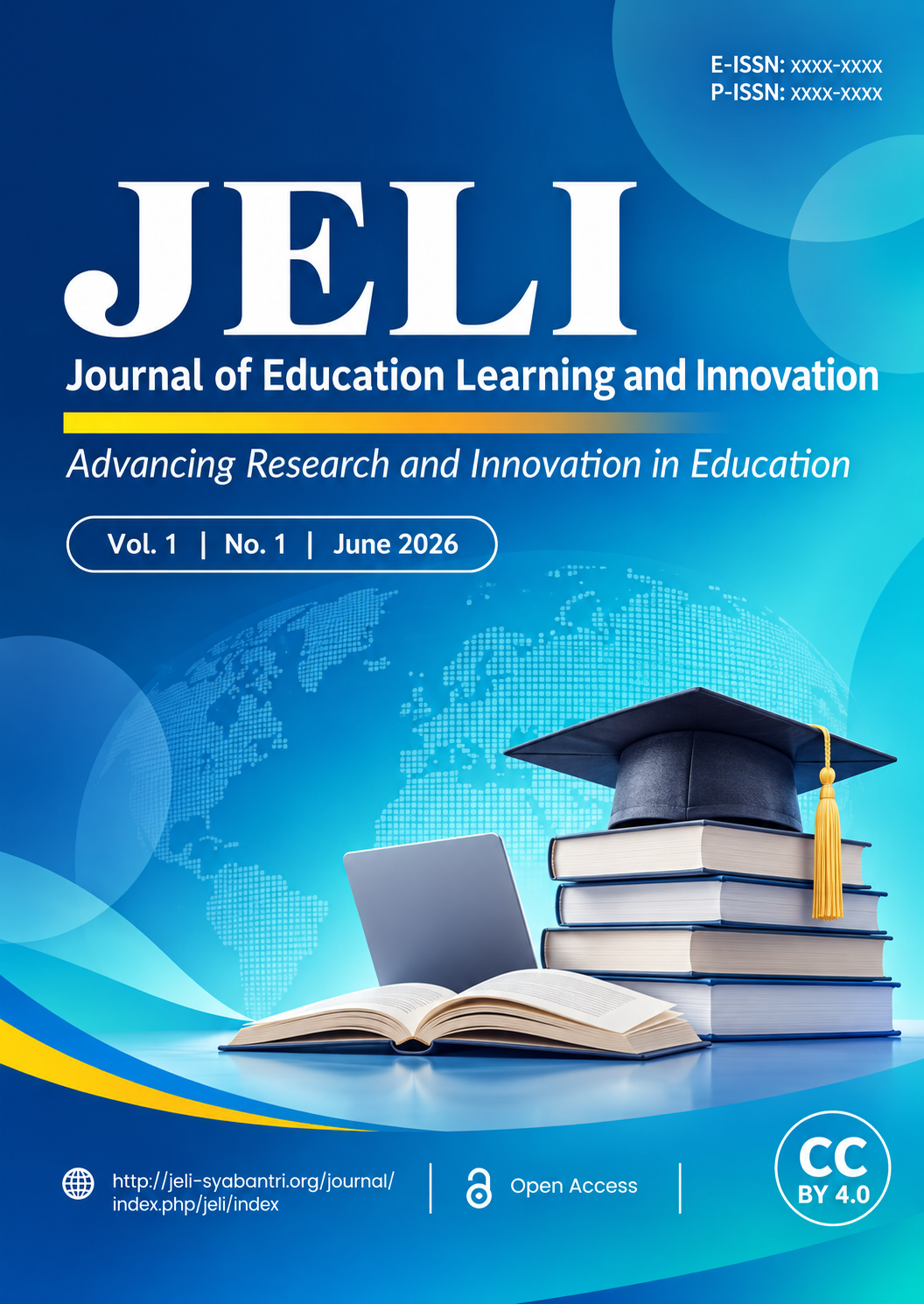
The Journal of Education, Learning and Innovation (JELI) is an international, peer-reviewed, open-access journal published by Syabantri Mandiri Berkarya. JELI publishes empirical and theoretical research that advances educational theory, practice, and policy, with emphasis on curriculum, instruction, assessment, educational technology, artificial intelligence in education, and pedagogical innovation.

  • Frequency: Two issues per year (January–July and July–December)

  • Review model: Double-blind peer review

  • License: CC BY 4.0

  • Language: English (preferred) or Indonesian


2. Scope

JELI welcomes manuscripts on:

  • Educational theory and philosophy

  • Curriculum development and evaluation

  • Learning, instruction, and differentiated teaching

  • Assessment, evaluation, and educational measurement

  • Teacher education and professional development

  • Educational technology and digital learning

  • Artificial intelligence, learning analytics, and generative AI in education

  • Pedagogical innovation and classroom action research

  • STEM/STEAM, inclusive education, and equity in learning

  • Systematic reviews and meta-analyses in education

Manuscripts that are purely technical without explicit educational implications are not within scope.


3. Article Types


Type Word count Notes
Original Research 5,000–8,000 Empirical study with clear methodology
Review Article 5,000–8,000 Critical synthesis of a field
Systematic Review / Meta-analysis 6,000–10,000 Follow PRISMA guidelines
Case Study 4,000–6,000 In-depth contextual analysis
Pedagogical Innovation Report 3,000–5,000 Documented innovative practice with evidence

Word count excludes references, tables, and figures.


4. Manuscript Preparation

  • File format: Microsoft Word (.docx)

  • Paper size: A4, margins 2.5 cm

  • Font: Times New Roman 12 pt, 1.15 line spacing, justified

  • Title: Maximum 15 words, bold

  • Abstract: 150–250 words (English), followed by Indonesian translation; 3–5 keywords

  • Structure: Introduction → Method → Results and Discussion → Conclusion → References

  • Tables and figures: Numbered, with captions; tables above, figures below

  • References: APA 7th edition, hanging indent, alphabetical order

  • Anonymity: Remove all author names, affiliations, and identifying information from the main manuscript file for double-blind review. Author details are entered separately in OJS metadata.


5. Submission Process

  1. Register an account at [URL OJS JELI].

  2. Read the Focus and Scope and Author Guidelines.

  3. Prepare the manuscript using the JELI Article Template.

  4. Submit via Make a Submission.

  5. Complete all required metadata: title, abstract, keywords, authors, affiliations, and ORCID (recommended).

  6. Upload:

    • Main manuscript (anonymized, .docx)

    • Title page (with author details, separate file)

    • Cover letter (optional but recommended)

    • Supplementary files (datasets, instruments, if applicable)

  7. Confirm that the submission complies with JELI’s ethical policies.


6. Peer Review Process

  • All submissions undergo an initial editorial screening (scope, completeness, similarity check).

  • Manuscripts passing screening are sent to at least two reviewers under double-blind peer review.

  • Typical review time: 4–8 weeks.

  • Decisions: Accept, Minor Revision, Major Revision, or Reject.

  • Authors receive reviewer comments and must submit a response letter detailing changes.


7. Publication Ethics

JELI follows COPE (Committee on Publication Ethics) principles. Authors must ensure:

  • The work is original and not published or under consideration elsewhere.

  • All authors have contributed significantly and approved the final version.

  • All sources are properly cited.

  • No fabrication, falsification, or plagiarism.

  • Conflicts of interest are declared.

  • Research involving human participants has ethical approval and informed consent.

  • AI tools used in writing or analysis are disclosed in the Methods or Acknowledgements.

Allegations of misconduct will be investigated according to COPE guidelines and may result in rejection or retraction.


8. Plagiarism Policy

  • All submissions are screened using plagiarism detection software.

  • Maximum similarity: 20% (excluding references and quoted material).

  • Manuscripts exceeding the threshold may be returned or rejected.


9. Use of AI Tools

  • Authors may use AI tools for language editing, literature support, or data analysis with disclosure.

  • AI cannot be listed as an author.

  • Authors are fully responsible for the accuracy and integrity of AI-assisted content.

  • Reviewers and editors must not upload manuscripts to public AI tools.


10. Copyright and Licensing

  • Authors retain copyright and grant JELI the right of first publication.

  • Articles are published under CC BY 4.0, allowing reuse with attribution.

  • Authors may deposit the published version in institutional repositories.


11. Article Processing Charges (APC)

[Pilih salah satu:]

  • JELI does not charge article processing charges. ATAU

  • JELI charges an APC of IDR [xxx] per accepted article. No fee is charged at submission.


12. References Style (APA 7th) — Quick Examples

Journal article:
Wijaya, B., & Rahman, C. (2024). AI in classroom assessment. Journal of Educational Technology, 15(2), 101–118. https://doi.org/10.xxxx/xxxxx

Book:
Santoso, A. (2023). Educational innovation in the digital era. Pustaka Edukasi.

Chapter:
Sari, D. (2022). Curriculum reform in Indonesia. In R. Hartono (Ed.), Education policy in Southeast Asia (pp. 45–67). Alfabeta.

Online source:
UNESCO. (2024). Guidance for generative AI in education and research. https://unesco.org/xxxx

Submission Preparation Checklist

All submissions must meet the following requirements.

  • This submission meets the requirements outlined in the Author Guidelines.
  • This submission has not been previously published, nor is it before another journal for consideration.
  • All references have been checked for accuracy and completeness.
  • All tables and figures have been numbered and labeled.
  • Permission has been obtained to publish all photos, datasets and other material provided with this submission.

Articles

Section default policy

Privacy Statement

The names and email addresses entered in this journal site will be used exclusively for the stated purposes of this journal and will not be made available for any other purpose or to any other party.